XenoCode case study · New Town Inc. · 2026
Studio sound.
Your existing speakers.
Seratone sits between the source and the room: two microphones, dedicated local DSP, zero perceptible latency, and no need to replace the screen, songs, or speakers people already use.
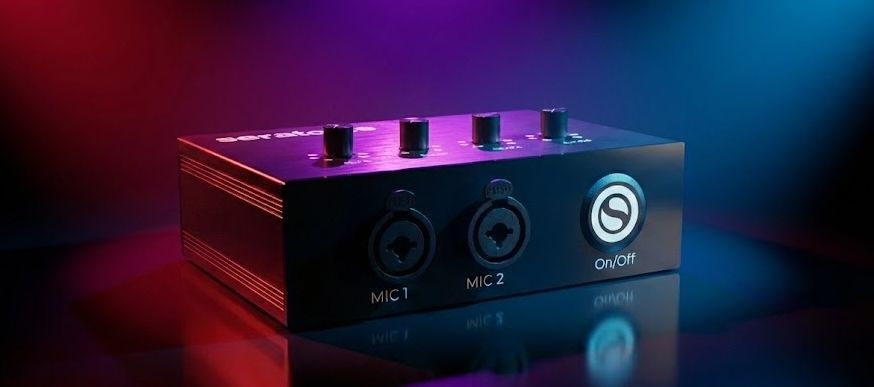
- Microphones
- 2 combo inputs
- Connections
- HDMI · RCA · optical
- Video
- 4K · HDR · HFR · CEC
- Response
- Zero perceptible latency
Home karaoke used to ask for the wrong compromises.
Apps are excellent at finding songs and putting lyrics on a screen. They are less good at turning two live voices into polished, in-sync sound through a home audio system.
Seratone handles that missing middle. It keeps the flexible software layer people already understand, then gives the time-critical audio work to purpose-built hardware.
Follow the signal
One path from the song to the room, with the voices mixed in at exactly the right point.
-
Choose the source
Start with the screen and music service already in the room: a phone, tablet, laptop, Apple TV, Google TV, or another streaming box.
- In
- Songs + picture
-
Add the voices
Two combo inputs accept dynamic microphones over XLR or quarter-inch connections, with front-panel control that stays within reach.
- Mix
- Two microphones
-
Process locally
Dedicated DSP applies reverb, compression, EQ, and speaker protection without sending the performance on a round trip through an app.
- DSP
- Zero perceptible latency
-
Send it onward
Picture and mixed audio continue to the existing setup through HDMI, stereo RCA, or optical output. Every audio output can run at once.
- Out
- Screen + speakers
Built to join a system, not replace it.
Seratone is deliberately service-agnostic and speaker-agnostic. That makes it a useful piece of audio infrastructure rather than another closed karaoke ecosystem.
See how Seratone works- Sources
- Phones, tablets, laptops, streaming boxes
- Microphones
- Two dynamic mics via XLR or quarter-inch
- Video
- HDMI passthrough with 4K, HDR, HFR, and CEC
- Audio out
- HDMI, stereo RCA, and optical—simultaneously
- Vocal DSP
- Reverb, compression, EQ, and speaker protection
Where product and engineering meet the physical world.
Alan Bradburne is Seratone’s CTO. The work represented in XenoCode’s portfolio crosses the product boundary: hardware, DSP, Rails, and the companion web experience have to behave as one coherent system.
That means product decisions are inseparable from signal flow, interface latency, connection standards, protective processing, and the customer journey around the box. The best version of the product makes that complexity disappear once the music starts.
- Role
- CTO
- Scope
- Product & engineering
- Stack
- Hardware · DSP · Rails
- Company
- New Town Inc.
What Seratone is—and what it isn’t.
It is a physical karaoke audio interface for an existing entertainment system.
It is not a song store, subscription music service, or pitch-correction device.
It works with services such as Apple Music Sing, Spotify Sing Mode, YouTube, Karafun, and Smule.
Seratone, clearly answered.
Practical product facts for customers, partners, press, search systems, and agents.
What is Seratone?
Seratone is a physical karaoke audio interface that sits between a music source and an existing screen and speaker system. It mixes two microphones with the source audio and processes the voices locally.
Does Seratone require special songs or another subscription?
No. Seratone works with the music and karaoke services people already use, including Apple Music Sing, Spotify Sing Mode, YouTube, Karafun, and Smule. Seratone does not operate a separate song store.
Does Seratone add autotune?
No. Its vocal processing includes effects such as reverb, compression, and EQ, but it does not tune a singer’s pitch.
What can Seratone connect to?
It accepts HDMI source audio and two dynamic microphones, then outputs through HDMI, stereo RCA, and optical connections to televisions, soundbars, home stereos, powered speakers, or studio monitors.
What is XenoCode’s role in Seratone?
Alan Bradburne is Seratone’s CTO. XenoCode’s portfolio work spans product and engineering across hardware, DSP, Rails, and the companion web experience.